

When stone materials are applied in the field of home furnishings, it is different from traditional finish decoration. One needs to master more complex techniques and more refined production standards.
The following 16 words are essential knowledge points in the process of stone decoration. Master these skills and you'll become a stone expert !
Dry cracks

Dry cracks: Refers to the cracks that appear on the surface of marble. These cracks are usually caused by the differences in the internal natural textures and grain compositions of the marble. Dry cracks do not affect the quality and performance of the marble.
Resin filling

The glue filling process: It means that when quality problems such as cracks, cuts, and holes appear on the surface of natural marble, transparent glue or crushed stone particles are used to fill them in order to repair and strengthen the surface of the marble.
Back mesh

The back mesh can enhance the strength and stability of the marble, ensuring its safety during transportation and use. In addition, the back mesh can also accelerate the installation process, reduce breakage and waste, and improve the installation efficiency and quality
Waterproof back glue

To increase its waterproofness and durability, a layer of waterproof back glue is usually applied to the back of marble. Waterproof back glue is a special type of glue that can effectively prevent water and moisture from penetrating into the interior of the marble slab, thereby reducing the wear and corrosion of the marble and prolonging its service life.
Cladding panel

Cladding panel" here means that some unscrupulous merchants wrap the large panels with poor surface quality inside those with good surface quality for sale. Customers who are not familiar with the business see that the large panels on the surface look good and buy them all. As a result, the goods inside are not the same as those on the surface. One can basically make a judgment by checking whether the sizes of the large panels are the same when looking at them from the side
Matching joint

Matching joint means joining two or more marble slabs together and adjusting the patterns and colors at the joint seams to achieve an effect of mutual echo, symmetry and naturalness
Matching the veins

Tracing the veins refers to creating artificial textures on the surface of marble slabs and splicing the textures of different marble slabs so that the textures at the splicing joints present a continuous and natural effect. This practice can make the marble surface look more natural and aesthetically pleasing.
With the grain

It means that the direction of the texture on the surface of the marble slab is the same as the direction of the slab's own texture, that is, parallel to the texture direction of the slab. This texture direction can make the marble slab present a natural, coherent and smooth effect.
Polished mirror surface

The crystal surface (polished mirror surface) refers to a surface treatment method in which the marble surface presents a high glossiness and mirror effect after high-speed grinding and polishing. It can make the marble surface look extremely smooth, flat, and bright. Meanwhile, it can also enhance the hardness and wear resistance of the marble.
Translucent

Some natural stones contain crystalline substances that are transparent or translucent in nature. When light shines on the marble from the back, part of the light will penetrate the crystalline structure of the marble, presenting a translucent or transparent effect.
Baking varnish

The baking varnish process is a type of surface treatment in which a layer of resin is applied to the surface of the marble and then baked at a high temperature. This process can make the marble surface present an effect similar to that of spray painting while maintaining the texture and grain of the natural stone, and also endows the marble with functions such as stain resistance and heat resistance
Putting on a film
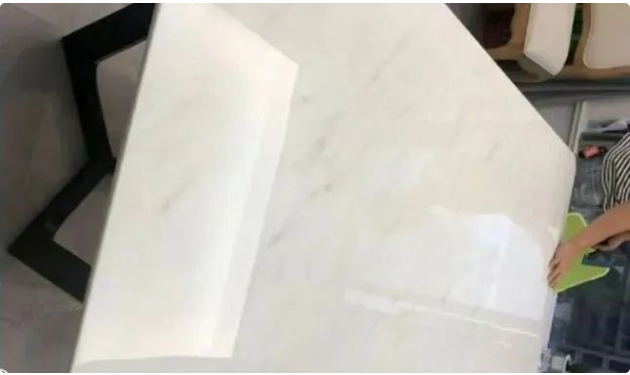
The film application process is a surface treatment technique that involves pasting a thin film on the surface of the marble countertop. This process can effectively protect the marble surface from being damaged by abrasion, scratches and stains. Meanwhile, it can also change the original color and texture of the marble itself, achieving diverse decorative effects
Maintenance

The maintenance process is a technique for the upkeep and care of the marble surface, which includes cleaning, protection, polishing, glue repair, waxing, etc. The marble maintenance process is an important task that can extend the service life of the marble material while maintaining its beauty and luster.
Alkali return

The efflorescence of marble refers to the phenomenon that alkaline deposits appear on the surface of marble. Usually, it is caused by the reaction of carbonates on the surface of marble with carbon dioxide in the air in a humid environment, producing bicarbonates. And the bicarbonates will combine with calcium ions in water to form insoluble calcium-alkaline salt deposits, thus resulting in the efflorescence phenomenon.
re - rusting

The rust recurrence of marble refers to the phenomenon that rust spots appear on the surface of marble. Usually, it is because the surface of marble comes into contact with substances containing iron ions. The iron ions then penetrate into the interior of the marble and react chemically with sulfides or organic substances therein, forming insoluble rust deposits, thus resulting in the rust recurrence phenomenon.
Seamless

Seamless means filling the joints, holes, etc. on the marble surface with a certain caulking agent to form a smooth and seamless effect with the surrounding marble surface. Generally, the caulking agent is selected from materials with colors similar to those of the marble to achieve the best aesthetic effect


